
How CNC Busbar Machines Improve Output in Nigerian Switchgear Workshops
2026-11-10
Topic: CNC / servo busbar efficiency in Nigerian workshops · changeover · FAT comparison
Brand focus: LTMC 303U-3-C · 503U-3-C · 803U-3-C
For: Switchgear, panel and busduct shops in Lagos, Abuja, Port Harcourt and Kano · three-phase 415 V / 50 Hz
Quick answer
A CNC or servo-assisted busbar machine improves output in a Nigerian switchgear workshop mainly by cutting repeated measuring and positioning, shortening repeat-order setup, and executing confirmed coordinates more consistently. Measure the benefit with minutes per conforming part, operator minutes, first-pass yield, changeover time, rework and net copper loss — not punch stroke speed alone. On LTMC 303U-3-C / 503U-3-C / 803U-3-C class machines, HMI and PLC bend modes and optional servo stops help most when the same panel or busduct drawings come back again and again.
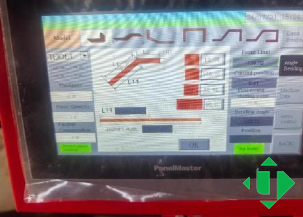
HMI mobile panel: six bending modes
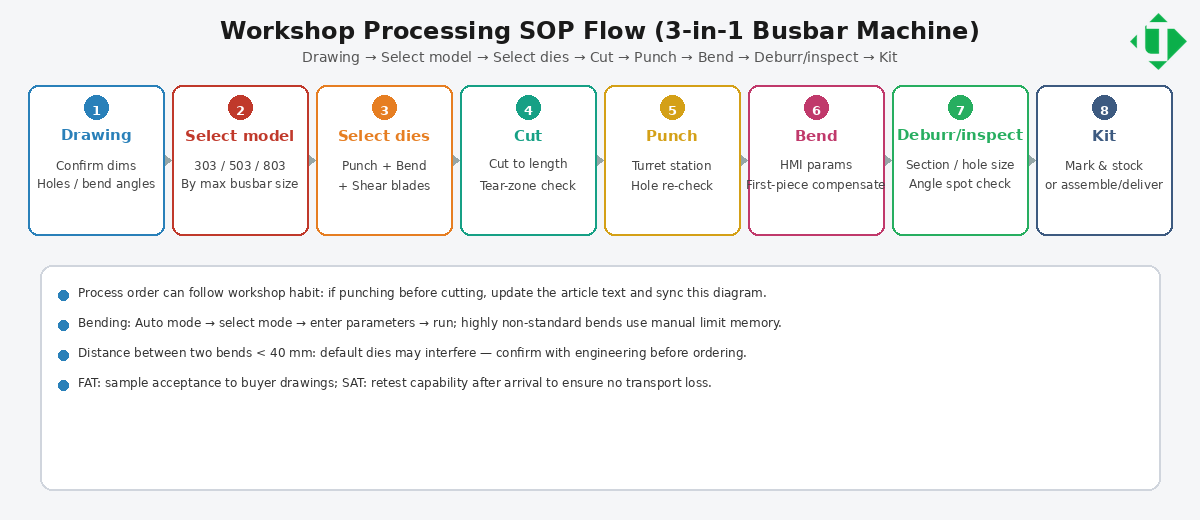
Workshop SOP flow: Drawing → Cut → Punch → Bend → Inspect
What “CNC” actually controls
CNC / servo may control length stops, hole coordinates, bend stroke/angle recipes, or stored programs—depending on configuration. It does not automatically mean automatic loading, tool change, or inspection. List every controlled axis and remaining manual step in the quotation.
Hydraulic force and CNC control are not mutually exclusive: many efficient cells use hydraulic stations with CNC/servo positioning and PLC bend libraries.
Where time is really saved
| Lever | What improves | Record this metric |
|---|---|---|
| Automatic / servo positioning | Less marking & ruler work | Positioning minutes per part |
| Stored programs | Faster repeat orders | Program-to-first-conforming-part |
| Prepared changeovers | Model A → Model B | Full changeover clock |
| Data / DXF import (if offered) | Less re-keying | Import → verified program time |
Only count axes that are truly CNC-controlled. Manual stations stay inside complete cycle time.
Metrics that matter
Evaluate under fixed drawings, material, tooling, operator, and inspection rules:
- Conforming parts per shift
- Complete cycle time (load → inspect)
- Operator minutes per conforming part
- First-pass yield
- Rework rate
- Net copper / aluminium loss
- Changeover time (last good A → first good B)
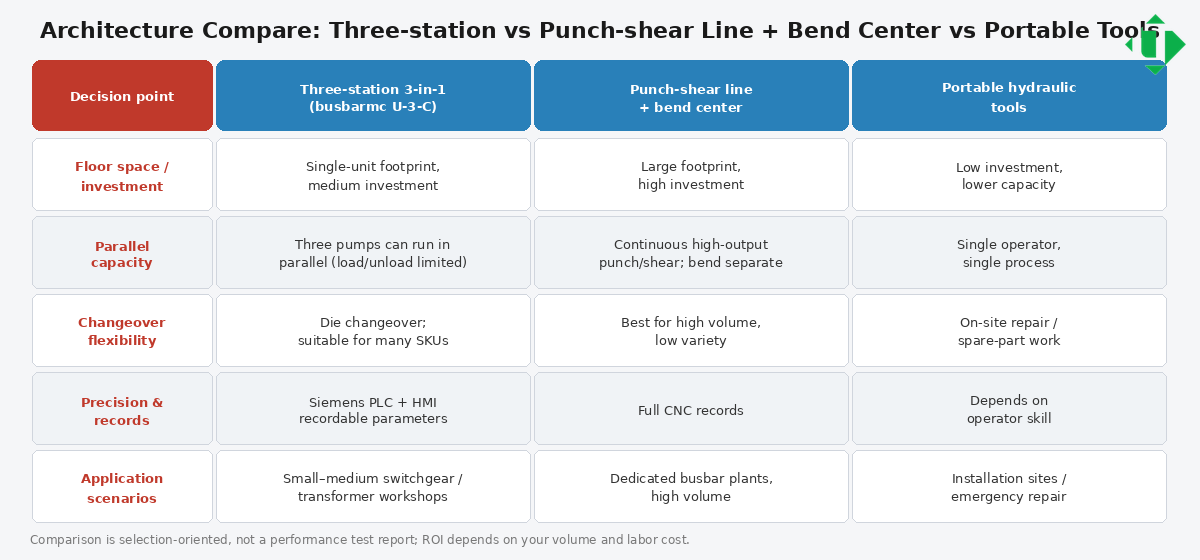
Architecture compare: 3-in-1 vs dedicated vs portable
Environments that benefit most
| Application | CNC saves time when… | Limitation |
|---|---|---|
| Switchgear panels | Breaker-hole kits & cabinet recipes recur | Drawing revision control |
| Transformers / distribution | Long/heavy bars need fewer re-measures | Still need support & capacity |
| Energy storage | Dense compact hole maps | First-article still mandatory |
| Mixed SME shop | Recipes cut setup chaos | Low-volume one-offs may not pay back |
Baseline test (HowTo) for FAT / supplier comparison
- Pick one approved copper (or Al) drawing used in production.
- Run a manual / basic baseline: record cycle, operators, defects.
- Run the CNC / recipe method on the same drawing.
- Compare conforming output and changeover—not peak stroke rate.
- Lock the winning program with drawing number + revision.
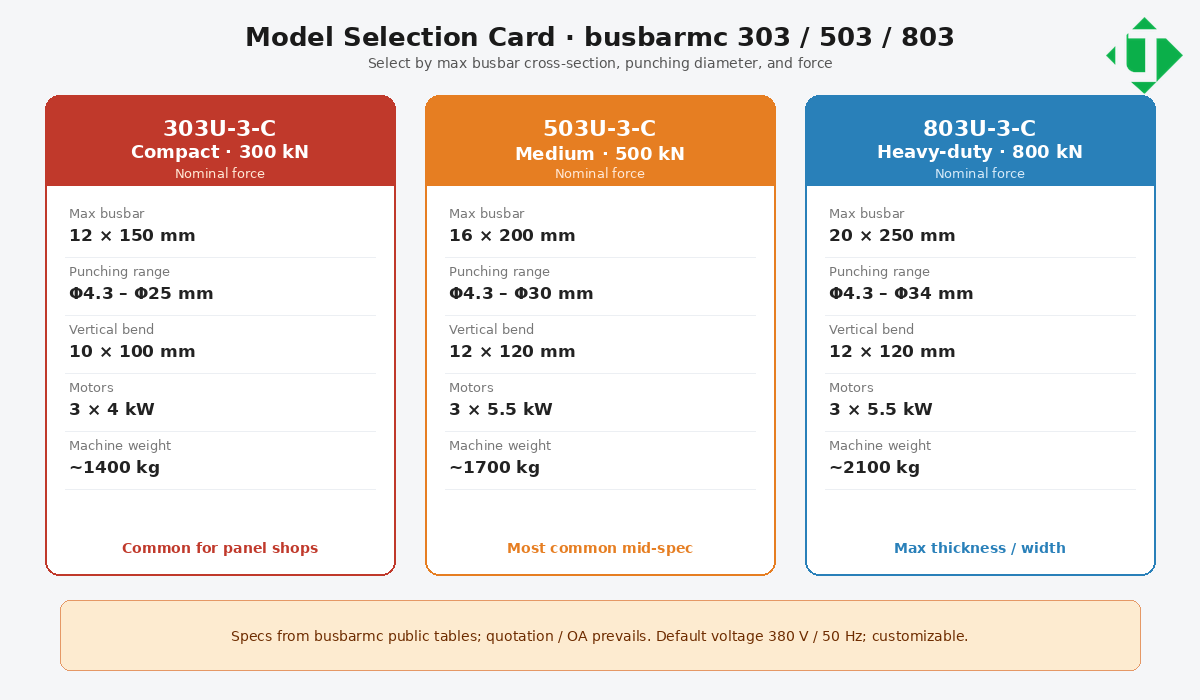
Model selection card: 303U-3-C / 503U-3-C / 803U-3-C
| Entity | 303U-3-C | 503U-3-C | 803U-3-C |
|---|---|---|---|
| Nominal force (kN) | 300 | 500 | 800 |
| Punching diameter (mm) | Φ4.3–Φ25 | Φ4.3–Φ30 | Φ4.3–Φ34 |
| Max thickness / width (mm) | 12 / 150 | 16 / 200 | 20 / 250 |
| Max horizontal bend (mm) | 150 / 12 | 200 / 16 | 250 / 20 |
| Max vertical bend size (mm) | 10×100 | 12×120 | 12×120 |
| Motor power | 3×4 kW | 3×5.5 kW | 3×5.5 kW |
FAQ
Do CNC machines always run faster than hydraulic 3-in-1s?
Not always. CNC helps when positioning/setup is the bottleneck. Pure stroke speed is a weak KPI.
Is HMI bend mode the same as a full CNC line?
No. PLC/HMI mode libraries improve bend repeatability; a full CNC line adds feeding, nesting, and automation scope. Confirm the quote.
What should I ask vendors to prove efficiency?
A side-by-side trial on your drawing with recorded conforming parts and changeover times.
Which LTMC features support efficiency?
Three independent pump groups, PLC bend modes, HMI recipes, and optional servo positioning—confirm options on OA.
Related technical guides
- How to Run a Busbar Bending Machine in a Nigerian Production Workshop
- 3-in-1 Busbar Processing Machine for Nigerian Panel Builders — Punch, Cut and Bend in One Frame
- How to Choose a Copper Busbar Machine for a Nigerian Panel Shop — Punch, Cut and Bend
- How a Busbar Bending Machine Works — Principles and Step-by-Step Operation for Nigerian Workshops
Talk to LTMC about a machine for a Nigerian workshop
If you are specifying a punch, cut and bend package for a switchgear, panel or busduct shop in Lagos, Abuja, Port Harcourt or Kano, tell us the copper or aluminium sizes you run, the daily piece count, and whether the machine will sit on a three-phase 415 V / 50 Hz supply. Lighting circuits at 230 V / 50 Hz are not suitable for these machines.
Sea freight is normally arranged to Apapa, Tin Can Island or Lekki Deep Sea Port in Lagos, with Form M and SONCAP documents prepared against the commercial invoice. Leanne will confirm voltage, dies and packing before the machine leaves the factory.
Email [email protected] or WhatsApp +86 13853146766. You can also use the contact form on this site. Public model pages: 3-in-1 busbar machines, 303U-3-C, 503U-3-C, 803U-3-C, plus CNC bending, CNC punching and cutting, and dies and moulds.