
What Is a Busbar Bending Machine? A Guide for Nigerian Switchgear and Panel Shops
2026-11-10
Topic: What a busbar bending machine is · selection · finished-part checks for Nigerian shops
Brand focus: LTMC 303U-3-C · 503U-3-C · 803U-3-C
For: Switchgear, panel and busduct shops in Lagos, Abuja, Port Harcourt and Kano · three-phase 415 V / 50 Hz
Quick answer
A busbar bending machine positions copper or aluminium bar relative to a bending die and applies controlled force to form drawing angles and geometries for Nigerian switchgear, panel boards, busduct and distribution equipment. Judge the machine by measured finished parts — released angle, bend-line position, inside radius, flanges, surface and batch variation — not by rated force or controller numbers alone. On LTMC 3-in-1 models (303U-3-C / 503U-3-C / 803U-3-C), the bend station covers flat and edge bends within the published envelopes.
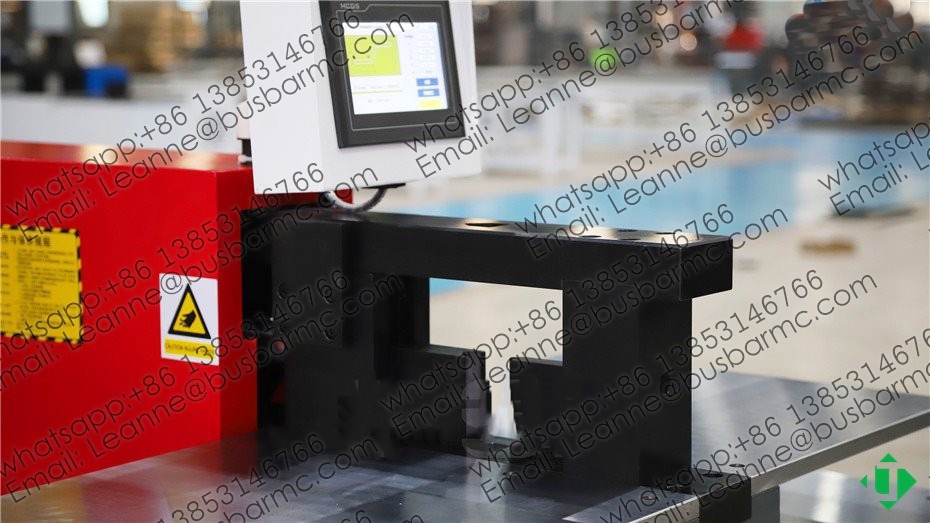
Bending unit with worktable and HMI
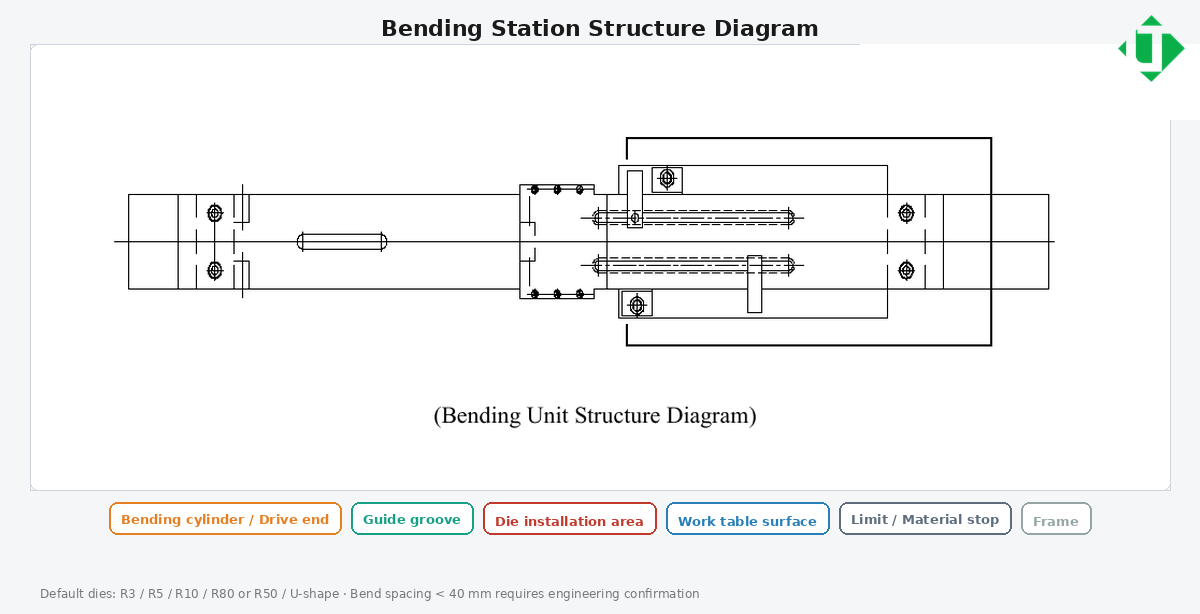
Bending station structure diagram (EN)
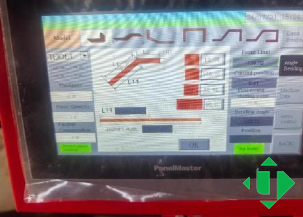
HMI mobile panel: six bending modes
What is a busbar bending machine?
An industrial forming unit designed for flat electrical conductors. It may be:
- The bend station on a 3-in-1 frame
- A dedicated busbar bender
- Occasionally a general press brake (only if capacity, tooling, and surface protection fit busbars)
Dedicated busbar designs focus on conductor widths, handling, and common L / U / Z / offset geometries.
How does it work? (process table)
| Step | What happens | Buyer verification |
|---|---|---|
| Position | Align bar to bend line | Datum, stop, support |
| Tooling | Install radius / U die | Radius vs thickness |
| Parameters | Stroke, mode, correction | Auto vs manual limits |
| Bend | Force forms the bar | Capacity + clearance |
| Release | Springback appears | Measure released angle |
| Inspect | Geometry + surface | Batch variation |
Displayed/programmed angle ≠ finished angle until springback is proven.
Finished-part results to verify
| Item | Why it matters |
|---|---|
| Released bend angle | Includes springback |
| Bend-line position | Flange / assembly |
| Inside bend radius | Tooling suitability |
| Flange & overall dims | Fit in cabinet |
| Twist / deformation | Installability |
| Surface marks | Contact & insulation |
| First / mid / last variation | Production stability |
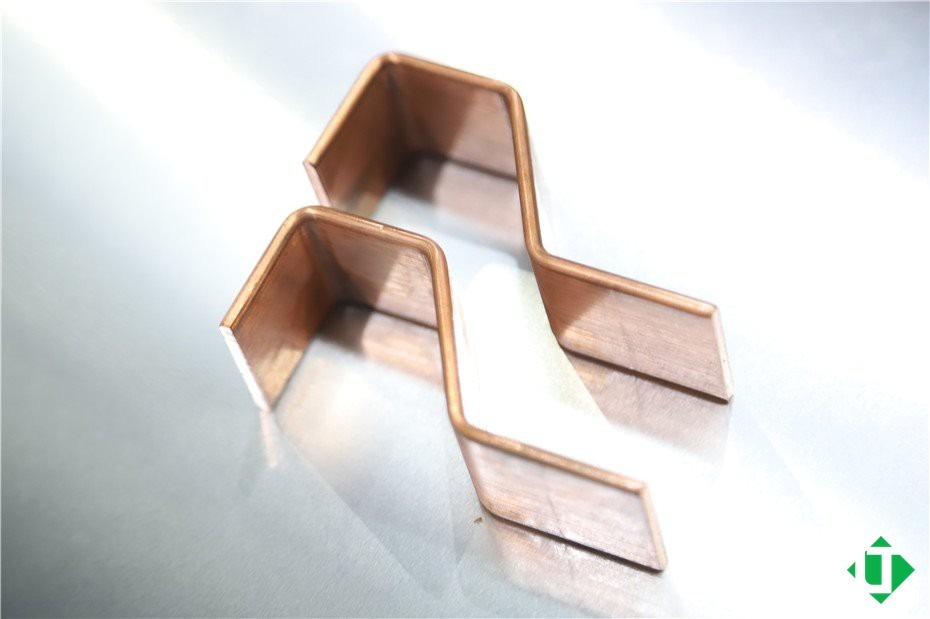
Copper Z / offset bend samples
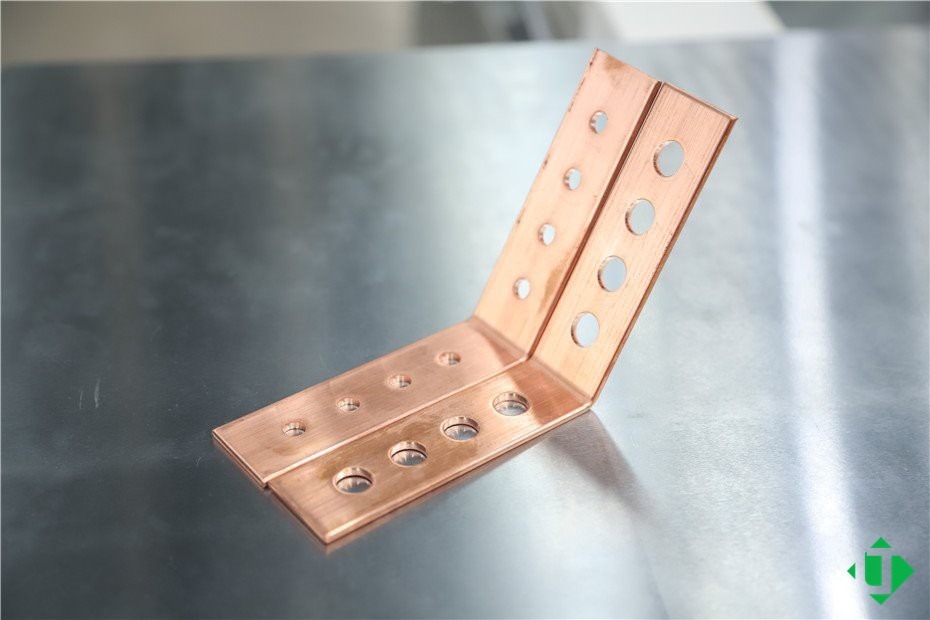
Copper samples after cut, punch and L-bend
Flat vs edge (vertical) bend
| Mode | Description | Capacity note |
|---|---|---|
| Flat / horizontal | Bend in the wide plane | Follows max width×thickness class |
| Edge / vertical | Bend in thickness plane | Tighter published size (e.g. 10×100 / 12×120 mm) |
Close bends with spacing under \~40 mm need engineering review.
Where bending sits on LTMC 3-in-1
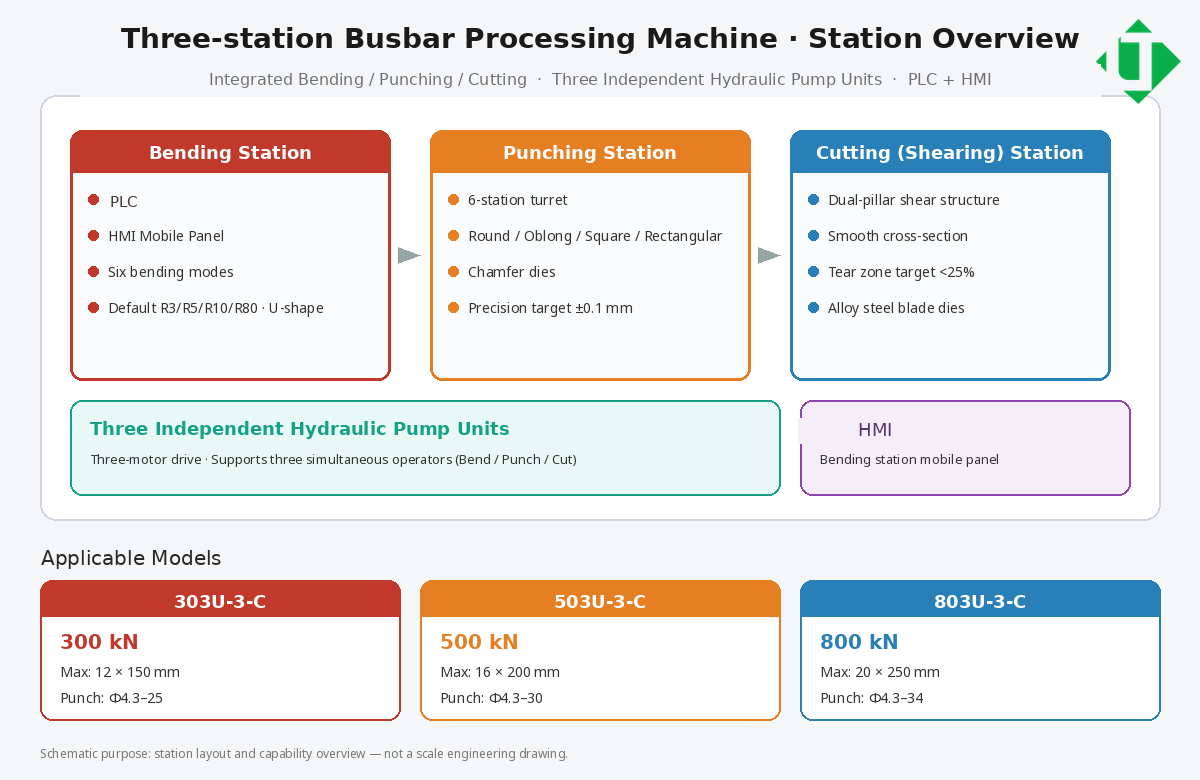
Three-station layout overview with English callouts
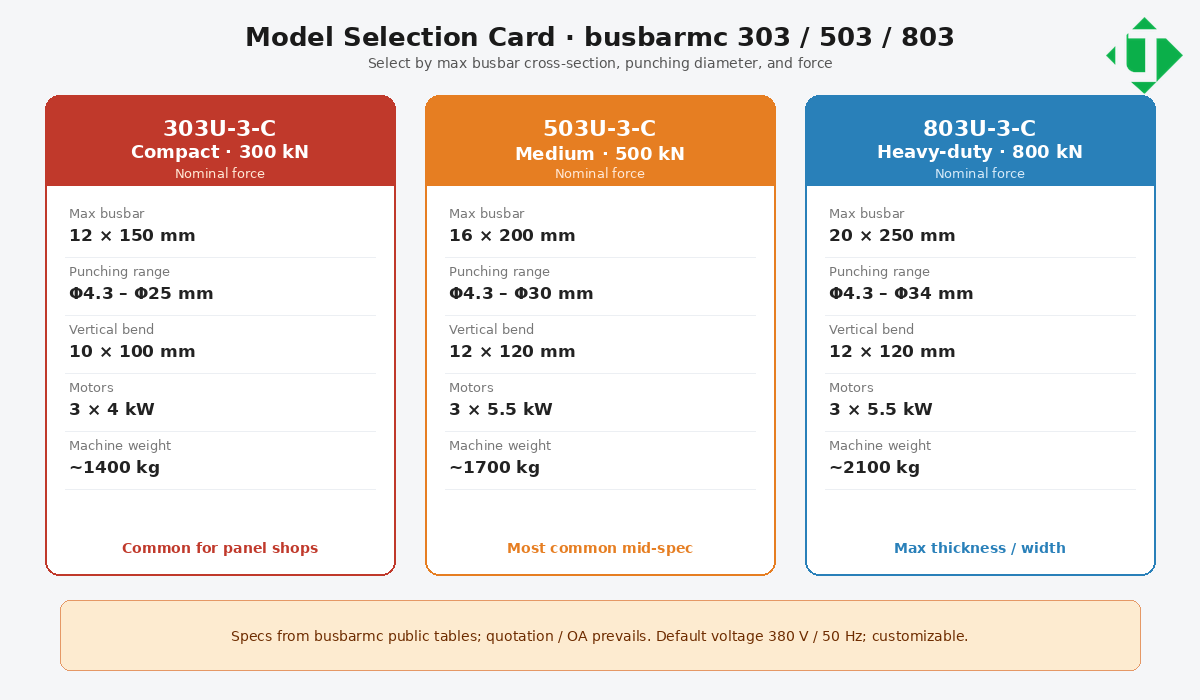
Model selection card: 303U-3-C / 503U-3-C / 803U-3-C
| Entity | 303U-3-C | 503U-3-C | 803U-3-C |
|---|---|---|---|
| Nominal force (kN) | 300 | 500 | 800 |
| Punching diameter (mm) | Φ4.3–Φ25 | Φ4.3–Φ30 | Φ4.3–Φ34 |
| Max thickness / width (mm) | 12 / 150 | 16 / 200 | 20 / 250 |
| Max horizontal bend (mm) | 150 / 12 | 200 / 16 | 250 / 20 |
| Max vertical bend size (mm) | 10×100 | 12×120 | 12×120 |
| Motor power | 3×4 kW | 3×5.5 kW | 3×5.5 kW |
Published bend precision on product pages: about ±1° / repeat ±0.5° (verify OA/FAT). PLC + HMI mode library supports auto (length/thickness/angle) and manual stroke limits.
Selection cues (not a workshop SOP)
This page is a selection / what-is guide. For step-by-step operator SOP and video-oriented HowTo, use the existing LTMC bending principles page under AI content creation—keep roles distinct.
Buyer checklist: material + temper, max section, flat vs edge list, radii, short legs, tolerances, volume, voltage, FAT samples.
FAQ
What is a busbar bending machine?
A forming machine (or station) that bends copper/aluminium busbars to drawing geometry with controlled dies and force.
Does tonnage equal bend quality?
No. Quality is the released part. Tonnage is only one capacity gate.
Can one machine do flat and vertical bends?
Often yes with the right tooling—confirm separate capacity limits.
Copper vs aluminium springback?
Aluminium usually needs larger compensation and careful min radius. Keep separate tables.
How do LTMC 3-in-1 bend stations help buyers?
Shared footprint with punch/shear, HMI modes, and published flat/edge envelopes on 303/503/803.
Related technical guides
- How a Busbar Bending Machine Works — Principles and Step-by-Step Operation for Nigerian Workshops
- How to Run a Busbar Bending Machine in a Nigerian Production Workshop
- Copper vs Aluminium Busbar Processing for Nigerian Panel Shops — Tooling, Clearance and Springback
- Three-Station Busbar Machine Guide for Nigerian Panel Builders — 303U-3-C, 503U-3-C and 803U-3-C
Talk to LTMC about a machine for a Nigerian workshop
If you are specifying a punch, cut and bend package for a switchgear, panel or busduct shop in Lagos, Abuja, Port Harcourt or Kano, tell us the copper or aluminium sizes you run, the daily piece count, and whether the machine will sit on a three-phase 415 V / 50 Hz supply. Lighting circuits at 230 V / 50 Hz are not suitable for these machines.
Sea freight is normally arranged to Apapa, Tin Can Island or Lekki Deep Sea Port in Lagos, with Form M and SONCAP documents prepared against the commercial invoice. Leanne will confirm voltage, dies and packing before the machine leaves the factory.
Email [email protected] or WhatsApp +86 13853146766. You can also use the contact form on this site. Public model pages: 3-in-1 busbar machines, 303U-3-C, 503U-3-C, 803U-3-C, plus CNC bending, CNC punching and cutting, and dies and moulds.